cupure logo

As Child Poverty Soars, UK Baby Banks Brace For The Toughest Winter Yet

As Child Poverty Soars, UK Baby Banks Brace For The Toughest Winter Yet
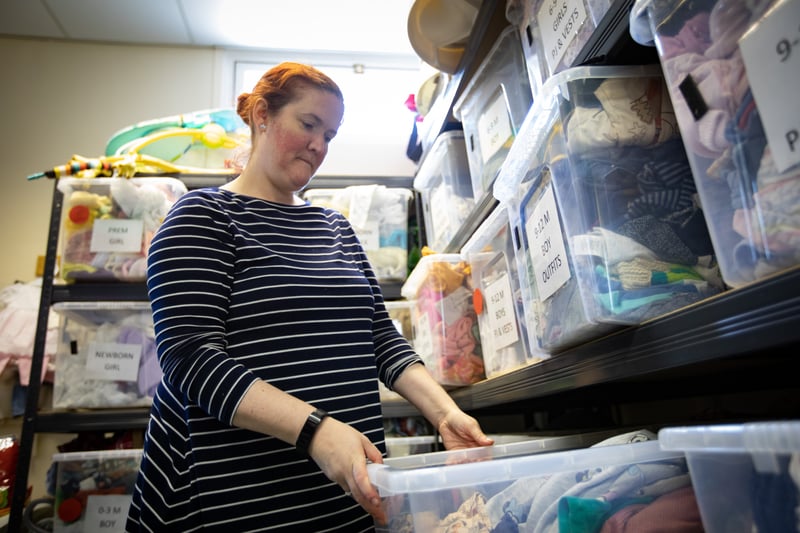
At Hartlepool Baby Bank, volunteers work tirelessly to support 100 to 150 families each week – families who can’t afford to buy underwear for their children, or need warm blankets and beds to stop their babies from freezing in their cold homes.What started as an initiative founded by three friends has quickly become a lifeline for pregnant women and families in the area. Emilie de Bruijn is one of the founders. She said since the baby bank was first set up in February 2019, demand has increased every year. “It feels like each year we see a couple of record highs. It’s not just that demand has grown, it’s the amount each family needs has grown as well. Each family needs more and more items than they did at the very start,” she told HuffPost UK. Baby banks are community-based organisations that provide essential items for babies and children, free of charge. This might be clothes, it might be nappies and wipes, or larger items like cots and pushchairs. When I ask de Bruijn why families seem to be struggling more than ever, she said the parents she helps are citing “rising food and fuel costs [and] how much the schools are asking them to provide”.Discussing the latter, she said: “It’s just so expensive now for a family in terms of uniforms, PE equipment, even just paying for the school dinners.“Everything has just kept increasing and increasing and increasing, and wages haven’t kept up, benefits haven’t kept up. It’s just really squeezing families.”On top of this, she said, “a lot of families tell us they went through their savings in Covid”.Hartlepool Baby Bank was set up in 2019 to help families with items from food and clothing to prams and nappies. It’s a similar picture for Bristol’s Baby Bank Network, which regularly runs out of certain items due to demand and is currently operating “at capacity”.“We know that need is increasing, and we could help more families if we had more space,” said Becky Gilbert, the baby bank’s co-founder.The organisation is currently gearing up for the busiest months. “We usually see an increase in referrals to our service over the winter period, particularly in the run up to Christmas,” she added. The same goes for Little Village, a network of baby banks in London, which HuffPost UK is supporting as part of its winter appeal. In 2023, they supported children aged 0 to 5 years old 8,529 times. Fast forward to this year and they’ve already supported children of the same age 9,309 times – and that’s not even taking into account the next few months, when need ramps up.Sophie Livingstone, Little Village’s CEO, said: “Families are having to make choices about spending money on heating or eating.”She added: “The need that families are experiencing is really significant and I would say that their situations are getting increasingly desperate – it’s really depressing to see.”Inside Little Village's baby bank in CamdenRecord numbers of children are living in poverty across the UKThere is soaring child poverty in the UK right now – and if nothing changes, it’s only going to get worse.According to the Child Poverty Action Group, 4.5 million children are growing up in poverty in the UK, which is almost one-third of children.Poverty significantly harms children’s health, wellbeing and life chances – and parents are often forced to make impossible choices between buying basics for their kids (like a winter coat or a pack of nappies) or paying the bills. Lots of the families supported by baby banks face additional challenges such as homelessness, fleeing domestic abuse, seeking refuge/asylum, or navigating mental health issues.But families where one or both parents are in work are also increasingly needing support, as de Bruijn puts it: “Working poverty is huge. It’s absolutely huge. We see lots of mums who are working 12-, 15-, 18-hour contracts and dad’s full-time, and still don’t [make ends] meet.”Jo Gregory, of The Hummingbird Project, a community-powered clothing, baby and hygiene bank in Glossop, said demand this year “has been 50% more than last year and has been extremely diverse in terms of who has accessed our support”.“We have helped no- and low-income families, as well as one- and two-income families who have seen the cost of living rise so much that they are struggling to afford necessities for their families, especially those who are due a baby and don’t have the money to buy all of the equipment needed.”Their baby bank works a little differently to the others – while other organisations might help people who have been referred by a professional, and/or those who self-refer, at The Hummingbird Project, people can walk in and select their own items (a bit like you would in a shop), but it’s all free.“We find that this really helps to remove the stigma attached to asking for items and therefore it has dramatically widened the pool of service users that access us,” she said.Both de Bruijn and Gilbert note hygiene poverty is also a huge issue families are facing. In the UK, 1.1 million children are lacking basic hygiene products. Bristol’s Baby Bank Network has given out over 8,000 toiletry packs – made up of items like baby wipes, nappy cream, shampoo, soap, a toothbrush and paste, and maternity essentials – in the past 10 years. “People [are] getting excited when you give them a pack of sanitary towels because they don’t have them,” said de Bruijn, echoing that there is a huge need among families to have basic hygiene essentials provided. The baby bank in Hartlepool is spending over £1,000 a month on nappies and wipes to hand out to families.“We give out toothbrushes, we give out toothpaste, we started a toiletry pack because we noticed that our families smelled and we didn’t want to embarrass them – so we made it open to everybody,” said de Bruijn. “And if you needed one, you took one; and if you didn’t, you left it for somebody else.“And we noticed that by bringing out those toiletry packs, the smell went away.” People [are] getting excited when you give them a pack of sanitary towels because they don’t have them.Emilie de Bruijn, Hartlepool Baby BankAll of the baby banks HuffPost UK spoke to form part of the Baby Bank Alliance, a network of 400 baby banks offering a lifeline to families up and down the UK.Dani Adams, its executive lead, told HuffPost UK that in 2024 alone, baby banks across the country supported more than 200,000 families and distributed over 3.5 million essential items. “Despite this, we know baby banks are struggling to meet demand,” she said. “As the cold months approach, the cost-of-living squeeze hits hardest: heating bills, winter clothing for children, bedding, and baby essentials add up, leading to a surge in referrals to baby banks.“Our members tell us that many of the families they support are working, but their money just doesn’t last until the end of the month. Even parents that both work are now needing help, especially at this time of year.”Emilie de Bruijn recalled how one mum, who worked for the NHS, visited the baby bank – her child, who was in a pushchair, had a hole in one of their shoes.The baby bank founder spotted it and quickly offered a replacement pair. But the parent, who was ashamed of not realising her child’s footwear was damaged, burst into tears.She explained they wouldn’t be able to afford to buy new shoes for a month or so, to which de Bruijn said she would replace them there and then. “There’s got to be more to life than this,” de Bruijn said. “It worries me what we’re doing for the esteem of these families and these children in the future – the mental health crisis is only going to get worse while we have people feeling like that.”Bristol's Baby Bank Network service manager, Katy, folds clothes and blankets to send out to families.Something has to changeNew analysis released today from the Unicef Global Office of Research and Foresight reveals the UK saw the largest increase in relative child income poverty of 37 high-income countries between 2013 and 2023 – an increase of 34%.Dr Philip Goodwin, chief executive officer of Unicef UK, said the impact of child poverty “can last a lifetime”. The overwhelming consensus among baby bank founders and poverty charities is that the two-child benefit cap needs to be abolished to tackle this pressing issue.The cap prevents parents from claiming universal credit or tax credit for their third or subsequent children. There are strong hints from government officials, including the prime minister himself, that this could soon be scrapped or changed.“The Autumn Budget is a pivotal moment, a chance for the UK government to rewrite the story for thousands of children and prove that their lives truly matter,” Dr Goodwin said.“Scrapping the cruel two-child limit policy for families in the UK is not just morally right, it is economically smart. It is the single most effective way to lift hundreds of thousands of children out of hardship.”The government is expected to release its Child Poverty Strategy later this month. It has already made some steps to help children across the UK – extending eligibility for free school meals and committing to invest £500m in family hubs.In the meantime, at every baby bank up and down the country, there are unsung heroes going above and beyond to help others who are struggling to afford the costs associated with raising children and, indeed, living. It’s not just packaging parcels to send to families, it’s sign-posting families to support, listening to their stories, being there when nobody else is.On one occasion, de Bruijn recalled a mum asked if she could help bring her newborn home from hospital after she gave birth alone (her husband needed to stay home to care for their other children, as they had no other support), which she did.The baby bank co-founder said driving the tiny infant home with his mum was one of her “proudest accomplishments”.“That’s the difference a baby bank can make,” she continued. “We gave her companionship, we gave her support, and we were really part of their safety net. And they repaid us by volunteering.”She describes baby banks as “the hearts of the community for parents”.“It’s not just about the items – some people think it’s very transactional, it isn’t. I could tell you the names of all the families that come in. They’re part of my village and I’m part of theirs.”To find and donate to your local baby bank, whether by volunteering, sending in high-quality items, or donating money, visit The Baby Bank Alliance.Related...Inside The Baby Banks Quietly Holding Britain's Families TogetherChildren In England Living In 'Almost Dickensian Levels Of Poverty'Exclusive: Ministers Slammed Over 'Tone Deaf' Social Media Post Amid Soaring Child Poverty
Comments

Breaking news