Francis Halzen Wins 2026 Nobel Prize in Physics for High-Energy Neutrinos
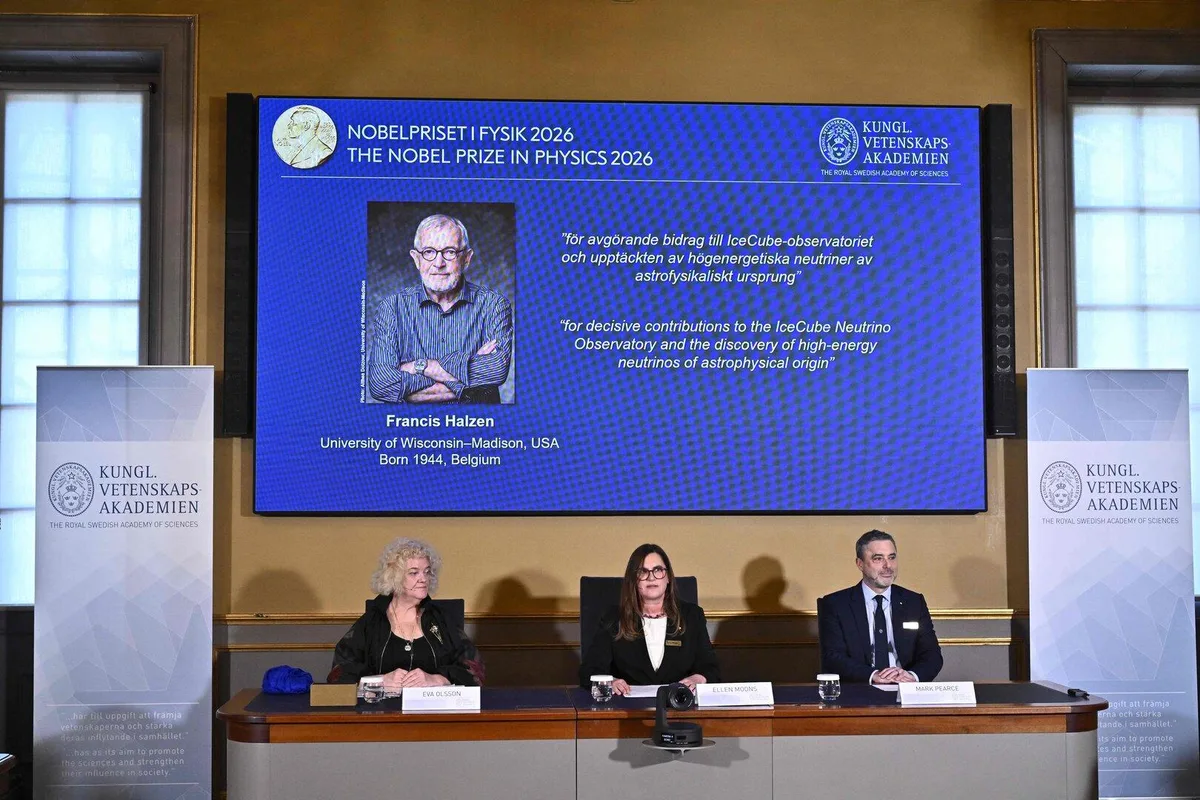
The 2026 Nobel Prize in Physics is awarded to Belgian physicist Francis Halzen for his significant contributions to the discovery of high-energy neutrinos. The announcement was made by the Royal Swedish Academy of Sciences in Stockholm.
The Royal Swedish Academy of Sciences awarded the 2026 Nobel Prize in Physics on Tuesday, October 6, to Belgian-American physicist Francis Halzen "for decisive contributions to the IceCube Neutrino Observatory and the discovery of high-energy neutrinos of astrophysical origin." Halzen, 82, is the sole laureate this year and will receive the full prize of 12 million Swedish kronor. The committee credited his vision and scientific leadership with turning a cubic kilometre of Antarctic ice into a telescope, and with opening a new way of observing the universe.
Who is Francis Halzen
Halzen was born in 1944 in Tienen, Belgium, and earned his doctorate at the University of Leuven in 1969. He has been on the faculty of the University of Wisconsin-Madison since 1972 and is the principal investigator of IceCube, an international collaboration of hundreds of researchers. Reached by phone in Italy during the announcement, he called the prize a big surprise and stressed that IceCube's success belongs to the whole collaboration. He is the second Belgian to win the physics prize, after François Englert in 2013.
The ghost particles
Neutrinos are among the most elusive particles known. They carry no electric charge, have almost no mass and barely interact with ordinary matter, so they pass through planets, stars and people without leaving a trace. On average, around ten billion of them cross every square centimetre of Earth's surface each second. The chair of the Nobel Committee for Physics, Mark Pearce, described them as ghostly messengers from space. The same property that makes them so hard to catch is what makes them valuable: they travel in straight lines, are not bent by magnetic fields and can escape from dense regions of space that light cannot.
A telescope made of ice
To catch even a handful of cosmic neutrinos, a detector has to be enormous. In the late 1980s Halzen proposed using the clear, dark and stable ice beneath the South Pole as the detector itself. He began working on AMANDA, IceCube's precursor, in 1987, which showed that a neutrino telescope buried in ice could work. IceCube was completed in 2010: thousands of light sensors hung on 86 cables in holes melted with hot water, between about 1.5 and 2.5 kilometres deep. When a neutrino does hit an atom in the ice, it produces charged particles that leave a faint blue flash known as Cherenkov light. By measuring when and how strongly the flash reaches each sensor, researchers can work out the neutrino's energy and the direction it came from.
The discovery
In 2013 IceCube reported evidence, published in Science, of a flux of very high-energy neutrinos coming from beyond our galaxy, energies too high to have been produced in Earth's atmosphere or the solar system. In September 2017 the detector recorded a single high-energy neutrino and pinned its direction to within about a tenth of a degree. The team shared the coordinates with other observatories, and NASA's Fermi space telescope found a flaring source of gamma rays in the same spot: the blazar TXS 0506+056, an active galaxy about 4 billion light years away. It was the first time a cosmic neutrino had been traced back to a likely source. Signals have since also been linked to the active galaxy NGC 1068 and to our own Milky Way.
Why it matters
For more than a century, scientists have struggled to explain where cosmic rays, the most energetic particles in the universe, come from. Because cosmic rays are charged, magnetic fields scramble their paths. Neutrinos produced alongside them point straight back to their birthplace, offering a way to locate the universe's most extreme natural particle accelerators, such as the surroundings of supermassive black holes. IceCube has made neutrinos a key part of multi-messenger astronomy, in which the same cosmic events are studied through light, gravitational waves, cosmic rays and neutrinos.
What comes next
The observatory is still growing. An upgrade adding hundreds of new sensors to the Antarctic ice was completed in 2026, a first step towards the much larger IceCube-Gen2. Halzen and the other 2026 laureates will receive their medals in Stockholm on December 10, the anniversary of Alfred Nobel's death.
Sources
- the GuardianNobel prize in physics goes to Francis Halzen for south pole work on neutrinos
- New ScientistNobel prize in physics awarded for discovery of high-energy neutrinos
- NatureNobel physics prize awarded for detection of ghostly neutrinos
- MEDIA INAFIl Nobel per la fisica 2026 va a Francis Halzen
- El ConfidencialFrancis Halzen, Premio Nobel de Física 2026