Robert E. Hall and Michael Woodford Win 2026 Nobel Prize in Economics
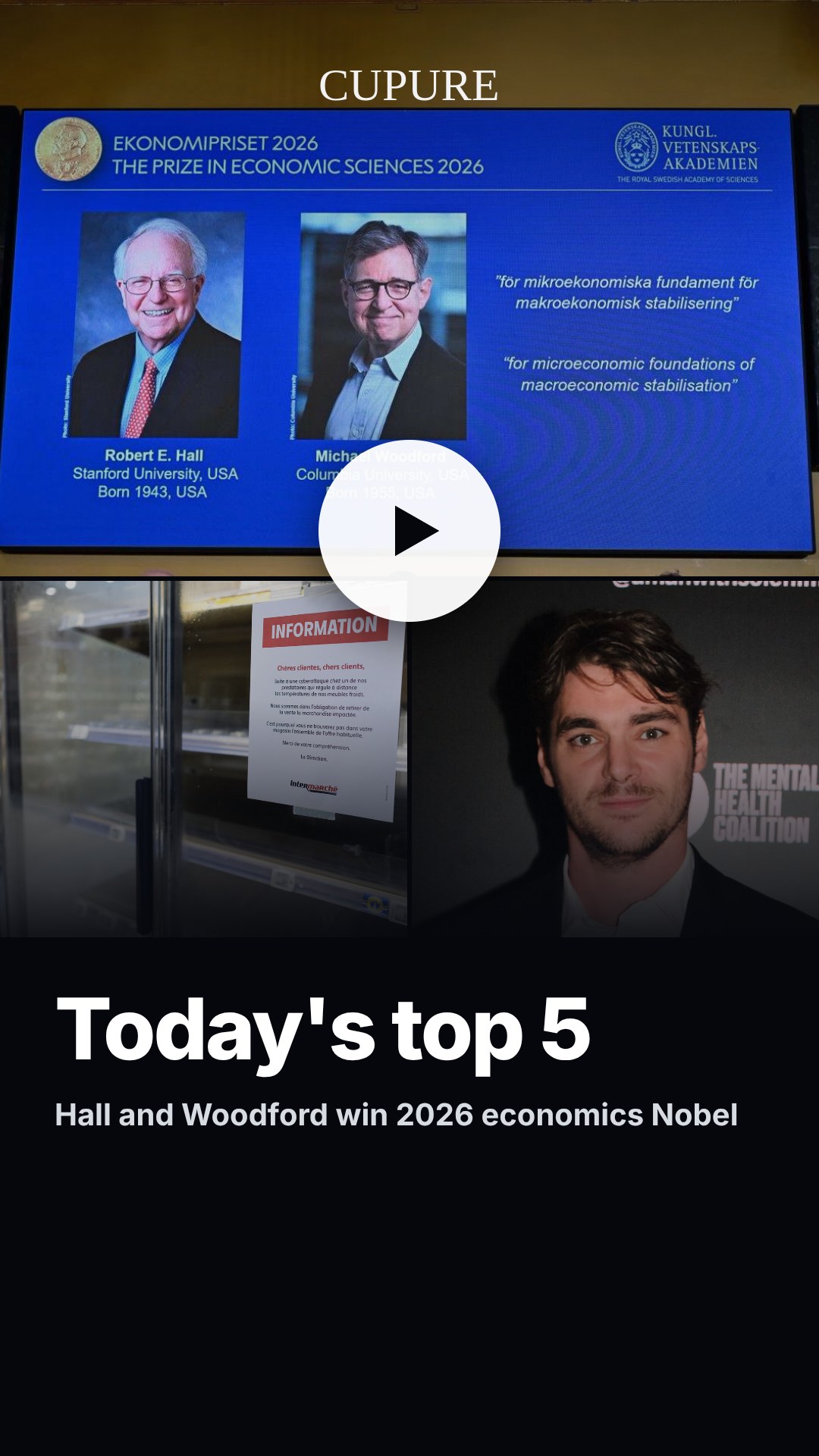
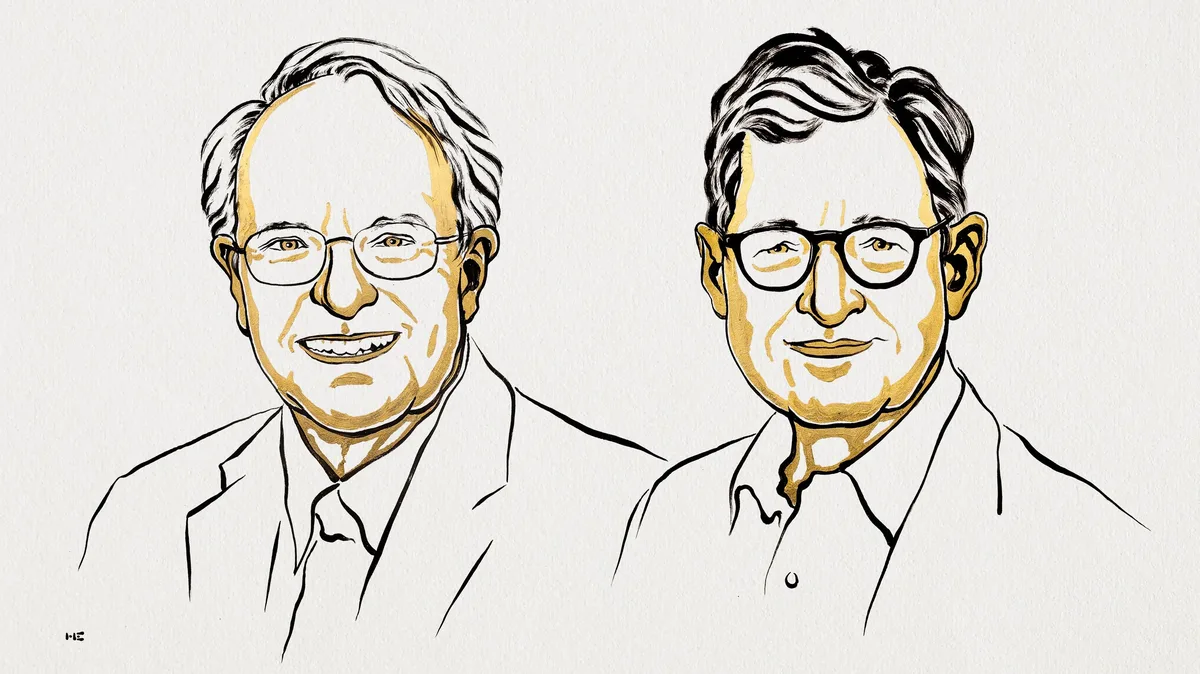
Robert E. Hall and Michael Woodford won the 2026 Nobel Prize in Economics for their work on the microeconomic foundations of macroeconomic stabilization.
The Royal Swedish Academy of Sciences awarded the 2026 Sveriges Riksbank Prize in Economic Sciences in Memory of Alfred Nobel on Monday, October 12, to two American economists, Robert E. Hall of Stanford University and Michael Woodford of Columbia University, "for the microeconomic foundations of macroeconomic stabilisation." In plain terms, they built models of the whole economy out of the decisions of individual households and firms, and used them to show how central banks and governments can soften booms and recessions. The Academy said well-timed monetary and fiscal policy based on these models can reduce the peaks and troughs of the business cycle, and that the models are now used by central banks and finance ministries around the world. The two share the prize of 12 million Swedish kronor, about $1.2 million.
Who are Robert Hall and Michael Woodford?
Robert Ernest Hall was born in Palo Alto, California, in 1943. He studied at the University of California, Berkeley, and earned his PhD at MIT in 1967 under Robert Solow, himself a Nobel laureate. He is a professor of economics at Stanford and a senior fellow at the Hoover Institution, was president of the American Economic Association in 2010, and is a member of the US National Academy of Sciences. Michael Woodford was born in 1955. He took a bachelor's degree at the University of Chicago in 1977, a law degree at Yale in 1980 and a PhD in economics at MIT in 1983. After posts at Chicago and Princeton he returned to Columbia in 2004 as John Bates Clark Professor of Political Economy.
What problem did they work on?
Economies swing between expansions and recessions, and those swings cost jobs and incomes. Since the 1970s, economists had argued that big-picture models of inflation, output and unemployment were unreliable for policy unless they rested on how real people and companies actually behave, and on what they expect about the future. Hall and Woodford helped supply those foundations. Committee chair John Hassler said their work gave a solid theoretical basis to the models used by central banks and governments, making it easier to respond to shocks such as energy crises or sudden changes in household spending.
Hall: consumption, jobs and sticky wages
Hall's best-known paper, published in 1978, studied how households spread spending over their lives. He showed that if people plan ahead and use all the information they have, changes in their consumption should be essentially unpredictable: today's spending already reflects everything they know, so only genuine surprises move it. The result, often called the random-walk theory of consumption, reshaped decades of research on saving and spending. Hall also worked on why unemployment rises so sharply in recessions, explaining wage stickiness through the costs firms face in searching for and hiring workers, and argued that companies' marginal costs and market power vary with the business cycle.
Beyond theory, Hall became one of the most visible arbiters of the US business cycle. He has long chaired the National Bureau of Economic Research's Business Cycle Dating Committee, the group that officially declares when American recessions begin and end. With Alvin Rabushka he also designed the Hall–Rabushka flat tax, which taxes income but not investment and has influenced tax-reform debates in several countries.
Woodford: interest rates, expectations and the New Keynesian model
Woodford, working with Julio Rotemberg, built one of the first New Keynesian models with careful microeconomic foundations: firms that set prices but cannot change them instantly, and households that plan for the future. His 2003 book "Interest and Prices", published by Princeton University Press, turned this into a full theory of monetary policy and became a standard graduate text. Woodford described his framework as "neo-Wicksellian", after the Swedish economist Knut Wicksell, because it centres on how a central bank's interest rate steers spending and inflation.
A central message of Woodford's work is that what a central bank says about the future can matter as much as what it does today, because households and firms act on their expectations. That insight underpins inflation targeting, in which a central bank publicly commits to an inflation goal, and "forward guidance", in which it signals the likely path of interest rates. Both became standard tools after the 2008 financial crisis, when many central banks had cut rates close to zero and could move markets mainly by shaping expectations. Woodford also contributed to the fiscal theory of the price level, which looks at how government budgets affect inflation.
How are these ideas used today?
Many of the models that central banks such as the US Federal Reserve and the European Central Bank use to forecast inflation and test policy options belong to the family Hall and Woodford helped build: models in which households smooth their spending, prices and wages adjust slowly, and expectations about future policy shape decisions today. When a central bank publishes its inflation target, explains how long rates will stay high, or weighs how a surge in energy prices will spread through the economy, it is using this toolkit. The New York Times summarised the committee's view as making policymakers better equipped to deal with shocks.
What do critics say?
The New Keynesian approach has been debated since the 2008 crisis. Critics argued that the standard models of the 2000s paid too little attention to banks, debt and financial panics, which turned out to drive the deepest recession in decades, and that the assumption of forward-looking, well-informed households may overstate how strongly people respond to central-bank announcements. Much of the research since then has added financial frictions and more realistic expectations to the framework rather than replacing it. The prize recognises the foundations, not a claim that recessions can be eliminated.
Awards and context
Woodford had already received the Deutsche Bank Prize in Financial Economics in 2007 and, in 2024, both the Erwin Plein Nemmers Prize in Economics and the BBVA Foundation Frontiers of Knowledge Award. The economics prize is not one of the five original Nobel Prizes; it was established by Sweden's central bank, the Riksbank, in 1968 and is awarded under the same rules. The 2026 laureates succeed Joel Mokyr, Philippe Aghion and Peter Howitt, honoured in 2025 for their work on innovation-driven growth.
What comes next
Hall and Woodford will receive their medals and diplomas in Stockholm on December 10, the anniversary of Alfred Nobel's death, after delivering their Nobel lectures. The award closes the 2026 Nobel season, which began on October 5 with the prize in physiology or medicine. With inflation, energy shocks and central-bank independence all high on the political agenda, their work on how policy expectations steer the economy is likely to stay at the centre of debate.
Sources
- NobelPrize.orgThe Sveriges Riksbank Prize in Economic Sciences 2026
- BloombergHTNobel Ekonomi Ödülü, Keynes'i yeniden yorumlayan kriz teorisyenlerine gitti
- The New York TimesRobert E. Hall and Michael Woodford Awarded Nobel for Economics
- CNBCNobel prize in economics awarded to Robert E. Hall and Michael Woodford
- Le MondeLe prix Nobel d'économie 2026 décerné aux Américains Michael Woodford et Robert Hall
- FranceinfoLe prix Nobel d'économie récompense Michael Woodford et Robert Hall
- WikipediaRobert Hall (economist)
- WikipediaMichael Woodford (economist)