Henri Kagan and Kenso Soai Awarded 2026 Nobel Prize in Chemistry
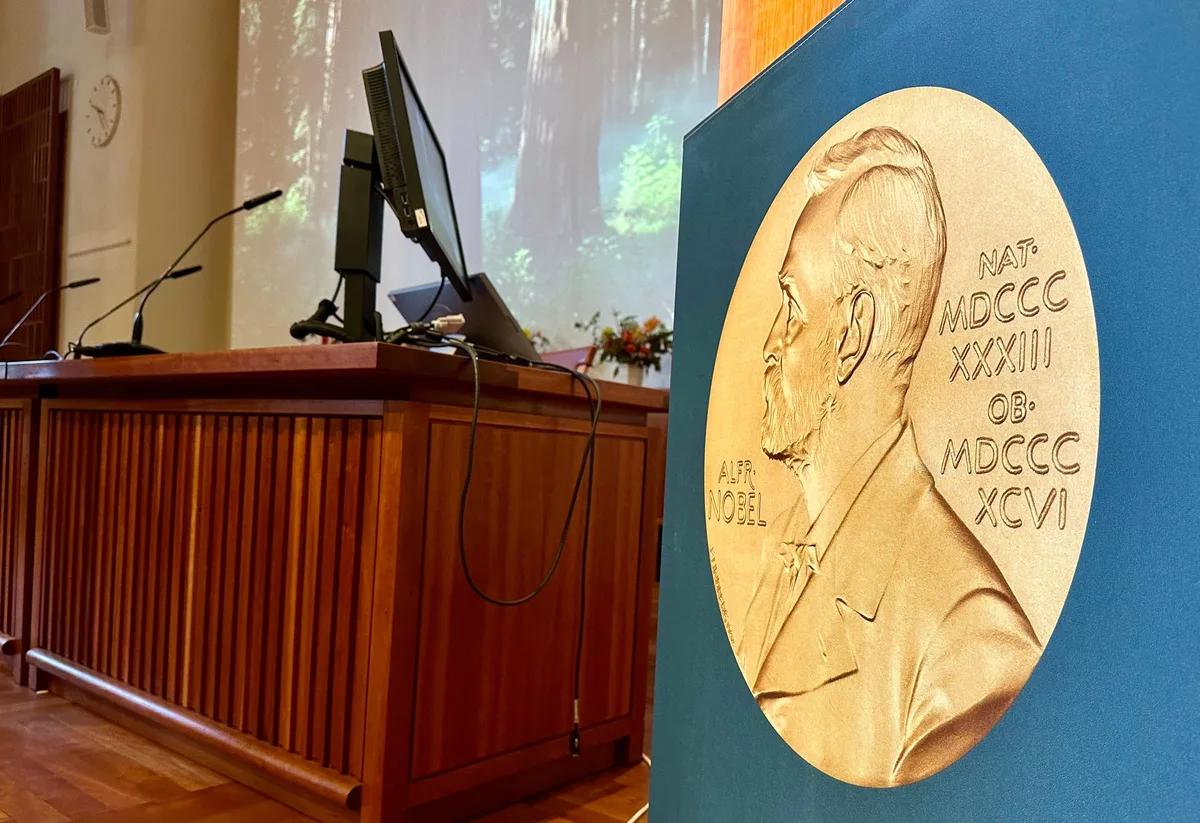
Henri Kagan and Kenso Soai received the 2026 Nobel Prize in Chemistry for their discovery of non-linear effects and autocatalysis in asymmetric organic synthesis, as announced by the Nobel Committee in Stockholm.
The Royal Swedish Academy of Sciences awarded the 2026 Nobel Prize in Chemistry on Wednesday, October 7, in Stockholm to Henri B. Kagan of France and Kenso Soai of Japan "for the discovery of non-linear effects and autocatalysis in asymmetric organic synthesis." Kagan, 95, a professor emeritus whose career was built at Université Paris-Sud in Orsay, and Soai, 76, a professor emeritus at Tokyo University of Science, showed how chemical reactions can be pushed to make one mirror-image form of a molecule rather than an even mixture of both. That matters for manufacturing medicines, where the two forms can act differently in the body, and for one of chemistry's oldest puzzles: why living things are built almost entirely from molecules of a single handedness. The laureates share 12 million Swedish kronor, about $1.2 million.
What are mirror-image molecules?
Many molecules that matter to life come in two versions that are mirror images of each other but cannot be stacked on top of one another, in the same way that a left hand will not fit a right-hand glove. Chemists call this property chirality, from the Greek word for hand, and the two versions enantiomers. Ordinary laboratory reactions usually produce both hands in equal amounts. Living organisms do not: the amino acids in their proteins are left-handed and the sugars in DNA are right-handed, a property known as homochirality. Nobel committee chair Heiner Linke described the laureates' work as a solution to a mystery more than a century old: "how homochirality can emerge spontaneously." The puzzle goes back to Louis Pasteur, who in the 19th century studied tartaric acid from winemaking and found that microbes ferment only the form found naturally in grapes.
Why does handedness matter for drugs?
A drug molecule works by fitting into receptors and enzymes that are themselves chiral, so its two mirror forms can behave very differently. "The left-handed version of the drug can have one effect, and the right-handed version can have another effect," committee member Peter Somfai said at the announcement, adding that the laureates had provided powerful tools for making each version selectively. The best-known warning is thalidomide, prescribed to pregnant women for morning sickness, which caused birth defects in thousands of children in the early 1960s; Reuters reported that researchers later traced the harm to one of the two mirror forms. The full story is less tidy: animal studies linked the defects to the S form, but the two forms convert into each other inside the body, so giving only the other form would still have produced some of the harmful one. The Spanish science magazine Quo notes that most countries now require chiral drugs to be sold as a single form. Somfai was careful about direct credit, saying it is difficult to name one drug that came from this work, because the ideas are used as general tools for designing catalysts.
What did Henri Kagan discover?
Kagan was already a pioneer of asymmetric catalysis, in which a small amount of a chiral catalyst steers a reaction toward one hand. In 1972 he and Dang Tuan Phat described DIOP, a chiral molecule that binds to a metal; paired with rhodium, it made hydrogenation reactions yield a clear excess of one enantiomer. The work honoured this year came in 1986, when his Orsay group reported the first examples of what he called non-linear effects. Chemists had assumed that a catalyst which is only partly pure in one hand would give a product exactly that pure. Kagan showed the relationship is not a straight line: a catalyst with a modest excess of one form can give a product considerably purer than itself. That means a small imbalance can be amplified, which made efficient production of single-handed molecules easier.
What is the Soai reaction?
Soai took the idea to its extreme. In 1995 his group reported in Nature a reaction in which pyrimidine-5-carbaldehyde reacts with diisopropylzinc to form a chiral alcohol, and that alcohol acts as the catalyst for making more of itself. Because each molecule of product tends to copy its own handedness, a tiny initial bias snowballs. According to Quo, a starting excess of about 0.00005 percent rose to a product more than 99.5 percent pure in one form after three rounds of autocatalysis. Tokyo University of Science describes it as the world's first example of asymmetric autocatalysis. Somfai called it "probably the coolest experiment in organic chemistry," and the committee described it as a feat no one had achieved "other than life itself."
Does it explain how life became single-handed?
The reaction is the strongest laboratory demonstration that a minuscule chiral imbalance can be amplified until one form dominates, a mechanism long proposed for how life's chemistry tipped to one side. Somfai said the work could help explain how life first arose, and Tokyo University of Science says it may help explain why biological molecules exist predominantly in one form. But it is a model, not a recreation of early Earth. Donna Blackmond of Scripps Research, whose group was first to work out how the Soai reaction proceeds, has written that such reactions could not happen under plausible pre-life conditions; the reaction relies on reactive organozinc chemistry, and her later work looked for amplification routes that could. Soai himself was cautious: "This is not the final answer," he said, according to Scientific American.
Who are the laureates?
Henri Kagan was born on December 15, 1930, in Boulogne-Billancourt, near Paris. His Jewish family escaped the Nazis during the Second World War by hiding in a French village under assumed names. He graduated from the École nationale supérieure de chimie de Paris in 1954, earned his doctorate at the Collège de France in 1960 under Jean Jacques, set up a laboratory at Orsay in 1968 and became emeritus in 1999. Kenso Soai was born in 1950 in Hiroshima Prefecture, earned his Doctor of Science at the University of Tokyo, where he studied under the organic chemist Teruaki Mukaiyama, and worked as a postdoctoral researcher at the University of North Carolina before becoming a professor at Tokyo University of Science. He received Japan's Medal with Purple Ribbon in 2012. Reuters noted that Kagan is the third-oldest person ever to receive a Nobel Prize.
How did they react, and was anyone overlooked?
Soai took the call while out shopping. "This is the most exciting day in my life," he told the press conference by phone, adding that he was glad to share the prize with Kagan; in a university statement he credited his students. The committee was still trying to reach Kagan when the prize was announced. French President Emmanuel Macron called it a recognition suited to a lifetime of research. For many French chemists the award settled an old grievance: the 2001 chemistry Nobel for asymmetric catalysis went to William Knowles, Ryoji Noyori and Barry Sharpless, and Reuters reported that the French research minister of the day complained to the Nobel Foundation that Kagan was left out. Kagan had shared that year's Wolf Prize in Chemistry with Noyori and Sharpless. Jacques Maddaluno, an emeritus CNRS researcher, told Le Monde the 2026 prize corrects a historical injustice.
What happens next?
Kagan and Soai will receive their medals from King Carl XVI Gustaf in Stockholm on December 10, the anniversary of Alfred Nobel's death, followed by the banquet at Stockholm City Hall. The scientific question the prize highlights remains open: researchers are still searching for an amplifying reaction that could have worked in the water-rich, mineral-laden settings of the young Earth. Soai has said there are still unknown aspects to the field.
Sources
- Al JazeeraHenri Kagan, Kenso Soai win Nobel chemistry prize for 'mirror image' work
- BusinessDay (Reuters)Nobel chemistry prize honours discovery of mirror-image molecules
- Tokyo University of ScienceNews release on Professor Emeritus Kenso Soai's 2026 Nobel Prize
- Scientific American2026 Nobel Prize in Chemistry awarded to Henri Kagan and Kenso Soai for their work in mirror chemistry
- WikipediaHenri B. Kagan
- Jewish NewsFrench Holocaust survivor wins 2026 Nobel Prize for Chemistry
- QuoThe Nobel Prize in Chemistry, homochirality and the thalidomide disaster (Spanish)
- Scripps ResearchNews & Views profile of Donna Blackmond (2011)
- ChiralpediaThe Thalidomide Paradox