2026 Nobel Prize in Medicine Awarded to Karl Deisseroth, Peter Hegemann, and Georg Nagel for Optogenetics Research
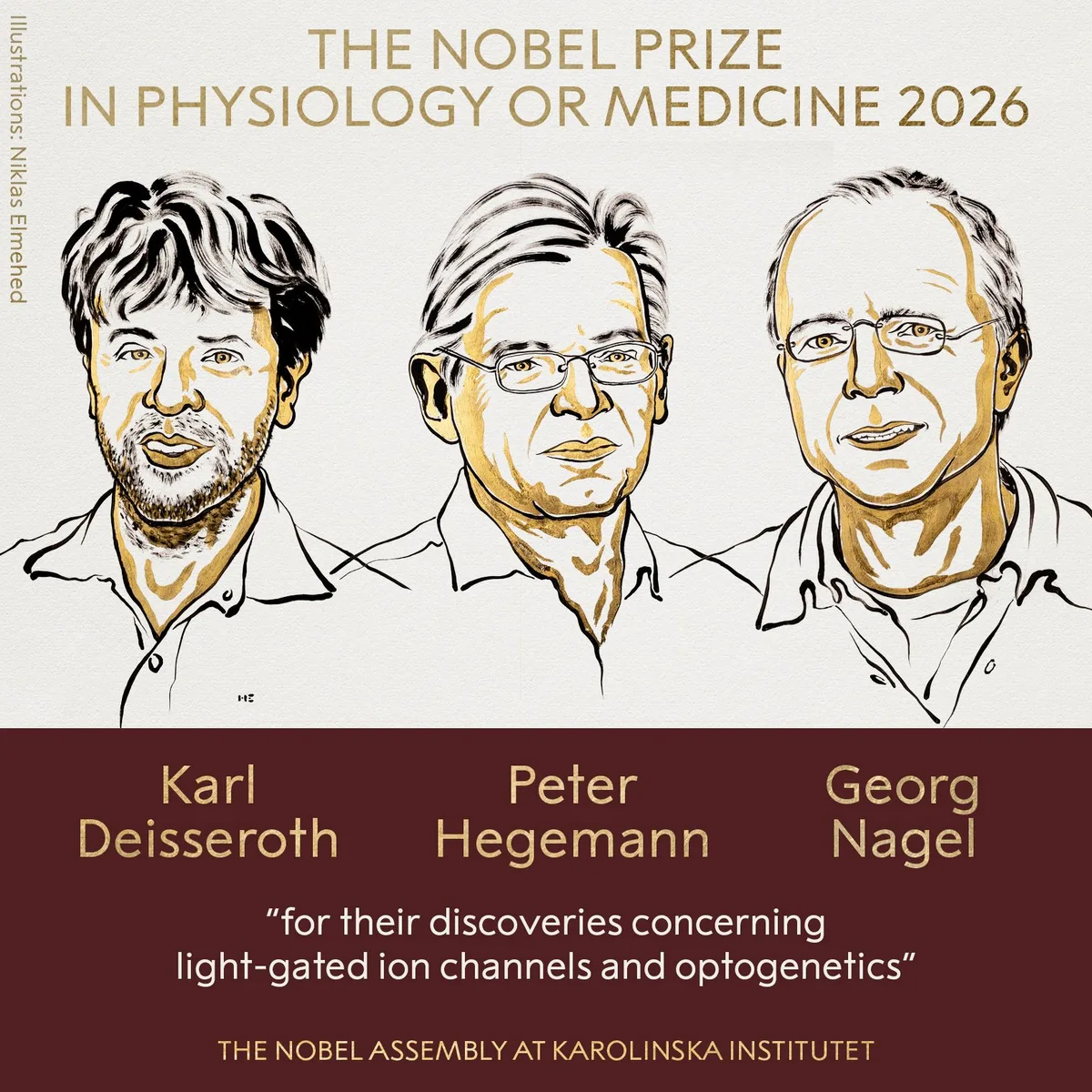
The 2026 Nobel Prize in Physiology or Medicine has been awarded to Karl Deisseroth, Peter Hegemann, and Georg Nagel for their groundbreaking work on light-gated ion channels and optogenetics, which enhances understanding of brain functions.
The Nobel Assembly at Karolinska Institutet in Stockholm awarded the 2026 Nobel Prize in Physiology or Medicine on Monday, October 5, to Karl Deisseroth, Peter Hegemann and Georg Nagel "for their discoveries concerning light-gated ion channels and optogenetics." Hegemann, 71, of Humboldt University of Berlin, and Nagel, 73, of the University of Würzburg, found a light-sensitive protein called channelrhodopsin in a single-celled green alga. Deisseroth, 54, a psychiatrist and bioengineer at Stanford University, turned it into a switch that lets scientists turn chosen nerve cells on and off with light. The three share the prize of 12 million Swedish kronor, about $1.2 million, equally.
Who are the three laureates?
Peter Hegemann was born in Münster in 1954 and trained as a chemist and biochemist, earning his doctorate at the Max Planck Institute of Biochemistry in 1984. He became a professor at the University of Regensburg in 1993 and moved to Humboldt University of Berlin in 2004. Georg Nagel was born in Weingarten in 1953, studied biology and biophysics in Konstanz and led a research group at the Max Planck Institute of Biophysics in Frankfurt from 1992 to 2004, when he became a professor in Würzburg. Karl Deisseroth was born in Boston in 1971, earned a PhD in neuroscience and an MD at Stanford, and still treats patients with treatment-resistant depression and autism alongside running his lab. Stanford says the committee's call reached his wife's phone at 12:27 a.m. Pacific time after he missed it.
The problem: watching the brain is not the same as testing it
The human brain contains roughly 86 billion neurons of many different types, wired into tightly packed circuits. For most of the 20th century, neuroscientists could record those cells firing or stimulate a region with electrodes, but electrodes activate every cell near the tip. That made it hard to answer the basic question of cause and effect: which specific cells, firing at which moment, produce a memory, a fear or a movement. The Nobel Assembly said the new method makes it possible to show how nerve cells shape memories, feelings and behaviour in the living brain.
An alga that swims toward light
The answer came from basic research with no medical goal. Chlamydomonas is a single-celled green alga with a small eyespot that steers it toward light. Hegemann had spent years studying how it senses light, and with Nagel and Ernst Bamberg at the Max Planck Institute of Biophysics he identified the protein responsible. In a 2002 paper in Science they described channelrhodopsin-1, and in 2003 in PNAS channelrhodopsin-2. Unlike the light-sensing proteins in our own eyes, which pass a signal through a chain of other molecules, channelrhodopsin is itself a channel: when blue light hits the retinal molecule inside it, the protein opens a pore and positively charged ions such as sodium flow into the cell.
From pond water to a switch for neurons
A neuron fires when positive ions rush in through its membrane, so a protein that lets them in on command could, in principle, make a neuron fire on command. Deisseroth started his Stanford lab in 2004 and began the project that year with two graduate students. In 2005 the team reported in Nature Neuroscience that mammalian neurons carrying the channelrhodopsin-2 gene fired in response to brief flashes of blue light, with millisecond precision. The same year Nagel and Alexander Gottschalk showed in Current Biology that the protein could drive behaviour in the roundworm C. elegans, the first use in an intact animal. Deisseroth's group went on to add a yellow-light-activated protein that silences neurons, and a thin optical fibre that carries light deep into the brain of a living mouse.
How optogenetics works in practice
Researchers deliver the gene for a light-sensitive protein to one chosen type of neuron, usually with a modified, harmless virus and a genetic "address" that limits where it is switched on. Only those cells become sensitive to light; their neighbours are unaffected. Light is then delivered through an optical fibre, and the targeted cells can be turned on or off in milliseconds. In a widely cited 2012 experiment involving Deisseroth, mice that had been given a mild shock froze in a completely different cage when light reactivated only the memory-centre neurons that had been active during the shock; mice never shocked did not freeze. Laboratories worldwide now use the method to study fear, memory, appetite, addiction and movement, as well as conditions such as depression, Parkinson's disease and epilepsy.
Has it helped patients yet?
Mostly not yet; optogenetics remains above all a research tool. The clearest human result so far came in May 2021, when a team led by José-Alain Sahel and Botond Roska reported in Nature Medicine that a 58-year-old man blinded by retinitis pigmentosa had partially regained sight. Doctors injected one eye with a virus carrying ChrimsonR, an algae-derived light-sensitive protein, into surviving retinal cells, and the man wore goggles that converted images into light pulses. With the goggles he could perceive, locate, count and touch objects; without them he could not. It was a single patient in an early-stage trial, and its authors described it as proof of concept rather than a treatment. Researchers are also exploring optogenetic cochlear implants, which could stimulate the auditory nerve more precisely than today's electrical devices.
Who else shaped the field?
A Nobel Prize can be shared by at most three people, and optogenetics had more pioneers than that. The 2013 Brain Prize and the 2019 Rumford Prize were each shared by six researchers: the three new laureates plus Ernst Bamberg of the Max Planck Institute of Biophysics, Edward Boyden of MIT, who was first author of the 2005 Nature Neuroscience paper, and Gero Miesenböck of Oxford, who showed in 2002 that light-sensitive proteins from fruit-fly eyes could activate mammalian neurons. Hegemann and Deisseroth also received the 2021 Lasker Award for Basic Medical Research. The Nobel Assembly has not commented publicly on who was left out.
What comes next
The laureates will receive their medals and diplomas in Stockholm on December 10, the anniversary of Alfred Nobel's death, and each will give a Nobel lecture in the days before. Deisseroth has said the priority is to get back to work. His lab is also known for CLARITY, a 2013 technique that makes brain tissue transparent, and Stanford's Human Neural Circuitry program, founded in 2023, studies real-time activity in the human brain. Nobel committee chair Per Svenningsson summed up the field's promise: optogenetics offers ways of mapping the brain that scientists "could once only dream of". Whether it becomes a routine treatment, beyond the eye and the ear, will depend on clinical trials that are still at an early stage.
Sources
- NobelPrize.orgPress release: The Nobel Prize in Physiology or Medicine 2026
- Stanford MedicineKarl Deisseroth wins 2026 Nobel Prize in physiology or medicine
- Inside Precision MedicineNovel optogenetic treatment leads to partial recovery of vision for blind patient (Nature Medicine, 2021)
- The ConversationHow pond algae led to a Nobel prize and a new way to study the brain
- Al JazeeraNobel medicine prize honours US and German scientists for optogenetics work
- MIT McGovern InstituteEd Boyden to share prestigious Brain Prize (2013)
- El PaísPremio Nobel de Medicina para Karl Deisseroth, Peter Hegemann y Georg Nagel
- Der TagesspiegelMedizin-Nobelpreis geht an Forscher aus Deutschland und den USA