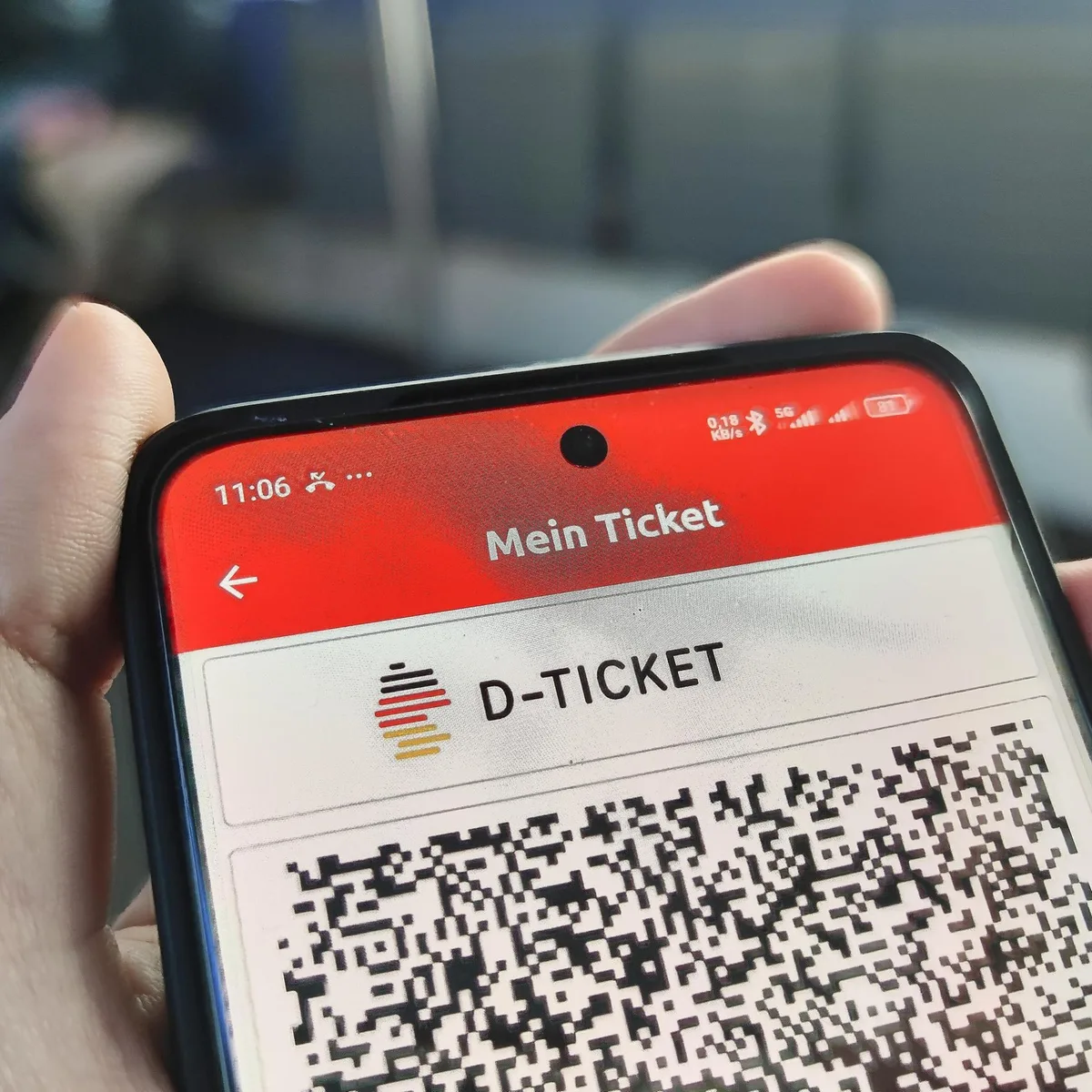
Deutschlandticket 2027: Why It Costs €66.80 and How the New Price Formula Works
From 1 January 2027 Germany's Deutschlandticket costs €66.80 a month. How the new index formula produced that price, what Jobticket, Semesterticket and social-ticket holders pay, the 30 November consent deadline for subscribers, and what comes next.
The Deutschlandticket, Germany's monthly subscription for unlimited local and regional buses and trains, will cost €66.80 from 1 January 2027, up from €63. The price was confirmed on 30 September 2026 and announced by Bavarian transport minister Christian Bernreiter (CSU), who chairs the states' Conference of Transport Ministers (Verkehrsministerkonferenz, VMK) in 2026. It is the first price set by a formula rather than by political bargaining: an index adopted in Lindau in March 2026 that tracks staff, energy and other operating costs against federal and state subsidies that are frozen until 2030. This page explains the formula, what discounted tickets cost, and what subscribers have to do before the change.
The rise is €3.80 a month, about 6 percent, and the third increase in three years: the ticket launched at €49 in May 2023, rose to €58 in 2025 and to €63 in 2026. According to the transport operators' association VDV, about 14.5 million people use it. The 2027 price was confirmed by the Deutschlandticket coordination council, in which heads of department from the federal and state transport ministries sit, and the Bavarian ministry gave staff, energy and general costs as the basis for the adjustment. Funding is unchanged: the federal government and the 16 states each pay €1.5 billion a year, a level the Bundesrat secured until 2030 in November 2025.
How does the new Deutschlandticket price formula work?
The VMK resolution of 25/26 March 2026 (agenda item 5.2) builds the price from a cost index multiplied by a value factor. The cost index weights staff costs at 55 percent (regional rail 16, buses 27, trams 12), energy at 20 percent (diesel 12.8, electricity 7.2) and other costs at 25 percent. The inputs are public statistics: Destatis producer prices for diesel sold to bulk buyers, for high-voltage electricity and for industrial goods excluding energy, each averaged over the twelve months to July, plus three wage indices for rail, bus and tram staff. Diesel is the single largest energy input; why diesel prices hit records in 2026 is covered in Cupure's diesel explainer.
The value factor exists because the €3 billion subsidy is not indexed: the resolution fixes it at €2.992 billion net (€3.2014 billion gross) until 31 December 2030. It equals 1 plus the subsidy divided by the previous year's ticket revenue, so it amplifies cost increases now but shrinks as revenue grows. The result is rounded to 10 cents; a negative index leaves the price unchanged. The private company D-Tix calculates the figure, an auditor checks it, and it must be announced by 30 September each year. The VMK did not publish the individual 2027 input values in the documents reviewed for this page. Before the decision, environmental group Deutsche Umwelthilfe estimated €66.40 using an assumed 4 percent cost rise and a value factor of 1.35.
What do Jobticket, Semesterticket, pupils and pensioners pay?
The Jobticket version costs €63.46 from 2027, up from €59.85, according to WirtschaftsWoche; that is 95 percent of the full price, a discount that applies when the employer pays at least 25 percent, ADAC reports. Nuremberg's operator VAG lists a maximum employee share of €46.76. The Deutschland-Semesterticket for students rises by €2.28 to €40.08, which is 60 percent of the full price; S-Bahn Berlin gives the same €40.08 as the maximum own share for its trainee ticket. There is no national discount for pupils or pensioners: reductions are set by states, cities or transport associations. Bavaria's reduced ticket is expected to cost €46.80 if the state keeps paying €20 of it, VAG says. Hamburg's social discount of €35.50 a month currently brings the price down to €27.50 for residents receiving basic income support, including old-age basic security; its 2027 level was not yet published.
Do subscribers have to agree to the price rise or cancel?
At Deutsche Bahn, yes. Existing subscribers must actively accept the contract change in the DB Aboportal or the DB Navigator app by 30 November 2026; if they do not, DB ends the subscription on 31 December 2026, though it can be reactivated until that date. Customers who ordered from 15 October 2026 were told the new price at purchase and need not confirm. S-Bahn Berlin applies the same 30 November deadline and said it would write to customers at the end of October. Regular cancellation (Kündigung) remains possible: DB and S-Bahn Berlin accept it until the 10th of a month, effective at the end of that month. Other regional sellers run their own processes, so subscribers should check their provider's portal.
Who criticises the increase, and who defends it?
Critics focus on timing: the Bundestag approved a three-month fuel discount of 17 cents per litre from October, which Der Tagesspiegel put at about €2.5 billion. Ramona Pop, head of the Federation of German Consumer Organisations (vzbv), warned of an automated price spiral; NRW transport minister Oliver Krischer (Greens) said the rise comes at passengers' expense; Jens Hilgenberg of BUND called it unacceptable alongside the fuel discount; and Deutsche Umwelthilfe launched a petition for a €29 ticket. Greens leader Felix Banaszak called for a price brake. Defenders point to costs: federal transport minister Steffen Bilger (CDU) called the rise justifiable, Brandenburg's Robert Crumbach (SPD) said the ticket stays very cheap, and VDV president Ingo Wortmann said operators cannot absorb the extra costs.
What about occasional riders, and what happens next?
North Rhine-Westphalia and Hamburg proposed a nationwide smartphone tariff in which riders check in and out, pay the cheapest fare and never more per month than a Deutschlandticket, modelled on NRW's eezy.nrw. At the VMK in Schwangau, Bavaria, the states postponed it on 21 October 2026; Bilger said funds were limited, then called it an interesting idea on 24 October. Key dates: 30 November 2026, consent deadline at DB and S-Bahn Berlin; 1 January 2027, €66.80 applies; by 30 September 2027, the 2028 price, the first to include a damping factor that passes 25 percent of revenue gains from rising ticket sales back as a smaller increase; spring 2029, the VMK reviews the formula for 2030; and 31 December 2030, the end of the frozen subsidy. A court has also allowed higher rail track charges for 2027, adding to operators' costs.
Sources
- Verkehrsministerkonferenz — Beschluss TOP 5.2: Preisindex Deutschlandticket (Lindau, 25/26 March 2026, PDF)
- Deutsche Bahn — Deutschland-Ticket: Kauf, Gültigkeit & Kündigung (price change and consent)
- VAG Nürnberg — Deutschlandticket: neuer Preis ab 1. Januar 2027
- hvv — Sozialrabatt für das Deutschlandticket
- ZDFheute — Deutschlandticket: Bundesrat sichert Finanzierung bis 2030 (21 Nov 2025)
- ADAC — Deutschlandticket im Nahverkehr: So teuer wird es 2027
- epd/Sonntagsblatt — Verkehrsminister: Deutschlandticket ab Januar 3,80 Euro teurer (30 Sep 2026)
- epd/Sonntagsblatt — 3,80 Euro mehr: Kritik am Preisanstieg des Deutschlandtickets
- Der Tagesspiegel — Preis für Deutschlandticket steigt ab Januar auf 66,80 Euro (30 Sep 2026)
- WirtschaftsWoche — Warum das Deutschlandticket ab 2027 teurer wird (30 Sep 2026)
- t-online — Deutschlandticket: Kunden von S-Bahn Berlin müssen Preiserhöhung zustimmen (25 Oct 2026)
- Der Tagesspiegel — Verkehrsminister der Länder wollen Deutschlandticket für Gelegenheitsfahrer (20 Oct 2026)
- Der Tagesspiegel — Crumbach: Nach Preisanstieg Deutschlandticket weiter günstig (6 Oct 2026)
- Deutsche Umwelthilfe — 74 Euro Ticketpreis und 1,8 Millionen weniger Abos bis 2030 prognostiziert (7 Nov 2025)
- Cupure — New Price for Germany's Deutschlandticket to Be Announced Today
- Cupure — States Delay Proposal for Flexible Deutschlandticket for Occasional Riders
- Cupure — German State Transport Ministers Plan Nationwide Local Transit Ticket for Occasional Riders
- Cupure — Germany's Deutschlandticket Boosts Public Transport Ridership
- Cupure — Bundestag Approves Fuel Discount to Reduce High Gas Prices
- Cupure — Court Approves Planned Rail Toll Increase for 2027
- Cupure — Why Diesel Hit Record Prices in 2026 — and What Could Bring Them Down